
Amazon dropshipping is a business model where a seller lists products for sale without keeping those products in their own inventory. When a customer places an order, a supplier or third party handles the physical fulfillment and ships the product to the customer.
The model can reduce the need for upfront inventory investment, but it does not remove the seller’s responsibilities. If you are planning to sell through Amazon, understanding how Amazon dropshipping works is important before choosing suppliers, listing products, or accepting your first order.
Amazon allows dropshipping when sellers follow its policies. One of the most important requirements is that the Amazon seller must remain the seller of record. Amazon also requires sellers to take responsibility for customer service, returns, and other obligations connected with the sale.
What Is Amazon Dropshipping?
Amazon dropshipping is a form of order fulfillment in which another company stores and ships the products you sell. Instead of buying a large quantity of inventory in advance, you work with a supplier that fulfills orders after customers purchase from your Amazon store.
For example, imagine that you list a kitchen organizer on Amazon for $30. A customer buys it from your store. You then send the order details to your approved supplier, who prepares and ships the product to the customer.
The difference between this model and traditional retail is that you do not normally keep the product in your own warehouse. Your supplier handles the physical product, while you manage the Amazon listing, sale, pricing, customer relationship, and other seller responsibilities.
That distinction is important because dropshipping does not mean handing your entire business over to a supplier.
How Amazon Dropshipping Works
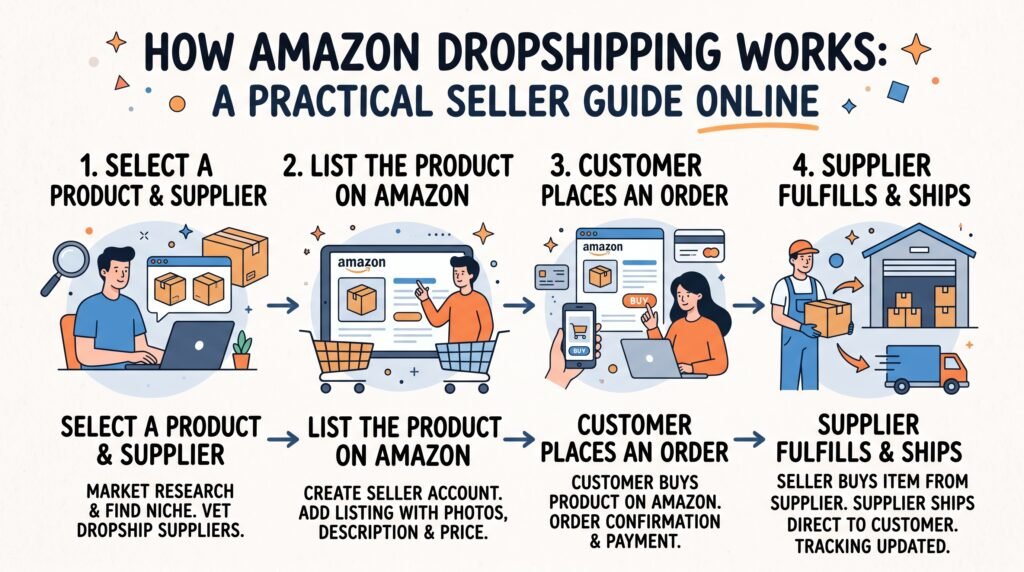
Understanding how Amazon dropshipping works becomes easier when the process is broken into individual steps.
1. Choose a Product
The process starts with product research. Sellers generally look for products that have consistent demand, manageable competition, reasonable profit potential, and reliable suppliers.
A good product should also be practical to ship and suitable for the Amazon marketplace. Before listing anything, sellers should check whether the product or category has specific Amazon restrictions or requirements.
Product research should consider more than the selling price. Supplier cost, Amazon fees, shipping expenses, refunds, returns, taxes, advertising costs, and other operating expenses can all affect the final margin.
2. Find a Reliable Supplier
After choosing potential products, the seller needs a supplier capable of fulfilling orders accurately and on time.
The supplier should understand that you are the seller of record. Amazon’s policy requires the seller to be identified as the seller on relevant packing slips, invoices, external packaging, and other materials connected with the shipment.
Before working with a supplier, it is sensible to ask about processing times, inventory updates, shipping methods, return procedures, product quality, packaging, and communication.
A supplier that offers a low product price but frequently ships late can create problems that cost much more than the savings.
3. Create Your Amazon Listing
Once you have a suitable supplier, you can create your Amazon product listing if you are permitted to sell that product.
The listing should accurately describe the product and provide information customers need to make an informed purchase. Product titles, images, descriptions, prices, variations, and other information should match the actual product being supplied.
Avoid making claims that the product cannot support. Accurate listings can help reduce customer complaints, returns, and negative feedback.
4. A Customer Places an Order
When a customer purchases the product through your Amazon listing, the order belongs to your Amazon business.
This is where the seller’s responsibilities become particularly important. You need to make sure the order reaches the supplier correctly and that the supplier can fulfill it within the required timeframe.
Your supplier may physically ship the product, but the customer is buying from your Amazon store. That means the customer experience still reflects on your seller account.
5. The Supplier Ships the Product
The supplier prepares and ships the order to the customer according to your fulfillment arrangement.
For Amazon dropshipping, packaging and documentation matter. Amazon states that sellers must be identified as the seller of record and that information identifying another seller or supplier should not appear on the shipment.
This is one reason why simply purchasing an item from another online retailer and asking that retailer to send it directly to your Amazon customer can create a policy problem. Amazon specifically identifies this type of arrangement as prohibited when the required seller of record conditions are not met.
6. You Remain Responsible for the Customer
After the order has been delivered, your responsibilities do not end.
If the customer has a question, wants to return the product, or reports a problem, you remain responsible for handling the matter according to Amazon’s requirements.
Amazon’s guidance states that dropshippers must be responsible for accepting and processing customer returns and must comply with applicable seller policies.
This is a key point for anyone learning how Amazon dropshipping works. The supplier handles fulfillment, but you remain accountable for the selling relationship.
Is Amazon Dropshipping Allowed?
Yes. Amazon states that dropshipping is allowed as long as sellers follow the Amazon Drop Shipping Policy and applicable laws and regulations.
The important issue is how the dropshipping arrangement is structured.
You Must Be the Seller of Record
The seller of record is the business responsible for the sale to the customer. Amazon’s guidance explains that the seller of record sets the selling price, records the purchase as revenue, and takes responsibility for sales tax where applicable.
Your supplier should not appear to the customer as the seller of the product.
Packaging Must Follow Amazon’s Requirements
Packaging, invoices, packing slips, and other materials connected with the order should identify you as the seller where required.
Amazon’s policy specifically prohibits shipments containing information that identifies another seller or supplier instead of you.
This should be discussed with your supplier before you start selling.
You Handle Returns
Dropshipping does not transfer your return responsibilities to the supplier. You need a process for handling customer returns and resolving problems in line with Amazon’s requirements.
A supplier should have a clear return process that allows you to deal with customer requests efficiently.
What Amazon Dropshipping Does Not Mean
There is a common misunderstanding that dropshipping means you can find a cheap product from any online store, list it on Amazon, and then have that retailer ship the order whenever someone buys it.
That approach can violate Amazon’s rules. Amazon specifically prohibits purchasing products from another online retailer and having that retailer ship directly to the customer when the required seller of record conditions are not met.
A proper dropshipping arrangement requires a supplier relationship that supports your responsibilities as the Amazon seller.
This distinction is especially important when evaluating suppliers. A supplier should be able to work within Amazon’s requirements rather than simply offering to forward retail orders.
What Are the Costs of Amazon Dropshipping?
One attraction of dropshipping is that you may not need to purchase large amounts of inventory before making sales. However, there are still several costs to consider.
Product and Supplier Costs
The supplier charges you for the product and, depending on the agreement, may charge shipping or other fulfillment fees.
Your selling price needs to leave enough room to cover these expenses while still producing a reasonable margin.
Amazon Selling Fees
Amazon sellers may have marketplace related fees depending on their selling plan, product category, fulfillment method, and other factors.
Because fee structures can change, sellers should check Amazon’s current fee information before calculating profitability.
Advertising and Marketing
Some products require advertising to gain visibility. Advertising costs can reduce profit even when a product has strong sales.
For that reason, sales volume alone does not tell you whether a dropshipping business is profitable.
Returns and Refunds
Returns can also affect your margins. A product may appear profitable until refunds, replacement orders, shipping costs, and other expenses are included.
A realistic profit calculation should account for these possibilities before you invest time in a product.
Benefits of Amazon Dropshipping
Dropshipping can be attractive because it changes how inventory is managed.
You may be able to start with less money tied up in physical stock because products are purchased from the supplier as orders are fulfilled. It can also make it easier to test different products without committing to large quantities of inventory.
Another advantage is that storage and physical fulfillment can be handled by a third party. This can reduce the need for your own warehouse space and shipping operation.
However, these advantages should be balanced against supplier dependence, Amazon fees, customer service responsibilities, and policy requirements.
Common Risks to Consider
Amazon dropshipping is not a guaranteed way to make money. Like any online selling model, it carries risks.
Supplier Problems
If your supplier runs out of stock, ships the wrong item, or takes too long to process an order, your customer may blame your Amazon store.
For this reason, supplier reliability can be just as important as product price.
Thin Profit Margins
Competition can make it difficult to maintain a healthy margin. If several sellers offer similar products, prices may fall while advertising and fulfillment expenses remain.
Before listing a product, calculate the expected profit after all relevant costs.
Policy Violations
Amazon policy violations can affect your ability to sell. Amazon has stated that violations of its dropshipping policy may lead to restrictions on selling through its Merchant Fulfilled Network.
That makes policy compliance a business issue, not simply an administrative detail.
Customer Service Issues
Customers generally do not care which company physically packed their order. They expect the Amazon seller to solve problems.
If your supplier is difficult to reach or does not provide accurate tracking information, you may have difficulty responding to customers quickly.
How to Choose an Amazon Dropshipping Supplier
A reliable supplier should be able to support your Amazon business rather than create additional problems.
Look for suppliers with clear processing times, dependable inventory information, suitable packaging, reasonable shipping options, and a documented returns process.
Ask whether the supplier can ship orders in a way that complies with Amazon’s seller of record requirements. It is also useful to test the supplier with sample orders before committing to a larger operation.
Do not choose a supplier based only on the lowest price. Communication, product consistency, shipping reliability, and return support can have a direct effect on your seller performance.
A Simple Amazon Dropshipping Workflow
The basic process can be summarized like this:
- Research a suitable product.
- Check Amazon’s product and category requirements.
- Find a supplier that supports compliant dropshipping.
- Confirm pricing, shipping, packaging, and returns.
- Create an accurate Amazon listing.
- Receive customer orders through Amazon.
- Send order information to your supplier.
- Have the supplier ship the product under the required seller of record arrangement.
- Provide customer service and handle returns.
- Review sales, costs, supplier performance, and customer feedback.
The workflow looks simple, but each stage needs proper attention. A mistake in supplier selection or fulfillment can affect the customer experience and the health of your Amazon business.
Final Thoughts on How Amazon Dropshipping Works
Learning how Amazon dropshipping works is only the first step. The real challenge is building a system that combines good products, reliable suppliers, accurate listings, sensible pricing, and responsible customer service.
Amazon does allow dropshipping, but sellers must follow the marketplace’s rules. The seller of record requirement is especially important. Your supplier should not appear to the customer as the seller, and you remain responsible for returns and the overall customer relationship.
If you decide to use this model, treat it as a real retail business rather than a shortcut to quick profits. Research your products carefully, verify your supplier before listing products, calculate costs realistically, and review Amazon’s current policies regularly. Rules and fees can change, so current Amazon guidance should always take priority over general advice found online.