
Amazon dropshipping can be an attractive business model for people who want to sell products online without keeping a large inventory at home. Instead of buying products in bulk and storing them yourself, you work with a supplier that fulfills orders after customers purchase them.
That sounds simple, but running a dropshipping business on Amazon requires more than finding a product and listing it for sale. Sellers need to understand Amazon’s rules, supplier relationships, pricing, customer service, returns, and the responsibilities that come with being the seller of record.
A good amazon dropshipping course should teach these practical areas rather than focus only on promises of quick profits. The goal is to understand how the business works and how to operate it responsibly.
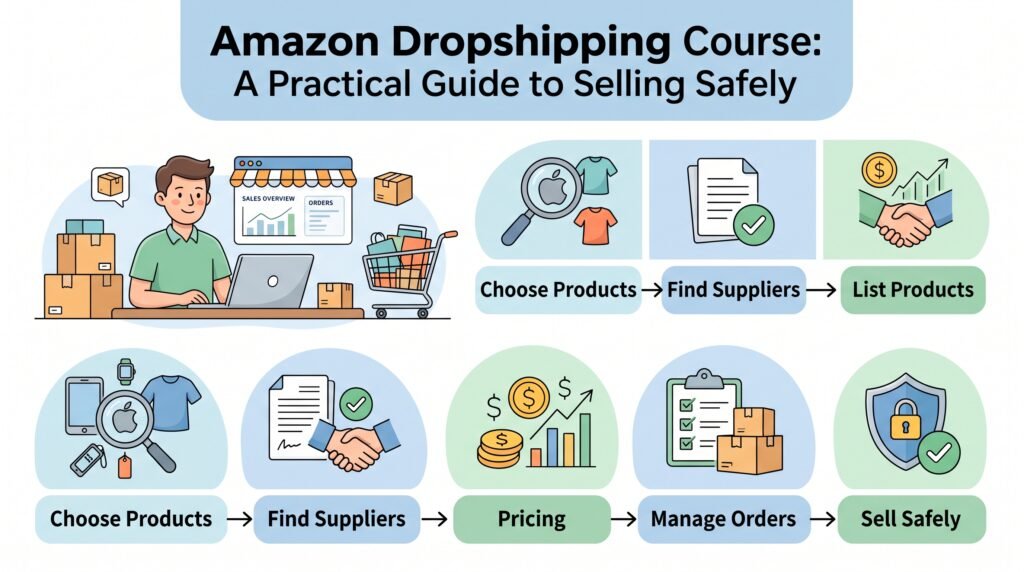
What Is Amazon Dropshipping?
Amazon dropshipping is a fulfillment method where a third party ships products to customers on your behalf. You list and sell the product, while the supplier or fulfillment partner handles the physical shipment.
Amazon states that dropshipping is generally allowed in its store when the seller remains the seller of record. This means the customer should understand that the Amazon seller, rather than an unrelated supplier, is responsible for the sale.
The model can reduce the need for upfront inventory investment, but it does not remove the seller’s responsibilities. You still need to manage your listings, pricing, customer communication, returns, and compliance with Amazon’s policies.
How the Business Model Works
The basic process usually looks like this:
- You research a product and find a suitable supplier.
- You create a product listing on Amazon.
- A customer places an order.
- You send the order information to your supplier.
- The supplier prepares and ships the product.
- You remain responsible for the customer’s experience and any required return handling.
The exact process depends on the supplier and fulfillment arrangement. Before listing products, sellers should confirm that the supplier can meet their shipping, packaging, documentation, and service requirements.
Is Amazon Dropshipping Legal?
Dropshipping itself is a legal business model. Amazon also states that dropshipping can be used in its store when sellers follow the applicable rules. Sellers must also comply with laws and requirements that apply in the markets where they operate.
The important point is that legality and marketplace compliance are not the same thing. A business activity can be legal in general while still violating Amazon’s seller policies.
For that reason, anyone taking an amazon dropshipping course should learn both sides of the business. Understanding general business law, tax responsibilities, consumer protection requirements, and Amazon’s seller rules can help reduce avoidable problems.
This information is educational and should not be treated as legal, tax, or financial advice. Requirements can vary by location and business structure, so professional advice may be appropriate for specific situations.
What Does Amazon’s Dropshipping Policy Require?
Amazon’s dropshipping rules focus heavily on the seller of record. Sellers using a third party to fulfill orders need to make sure the customer sees them as the seller.
Amazon’s published guidance says sellers using a dropshipper should have an agreement with the supplier that identifies the seller as the seller of record on packing slips, invoices, external packaging, and other information supplied with the products.
You Must Be the Seller of Record
The seller of record is responsible for the transaction with the customer. Your business should be identified as the seller rather than allowing the supplier to appear as the seller.
This distinction is one of the first things a beginner should understand before starting Amazon dropshipping.
Supplier Information Should Not Appear as the Seller
Amazon’s policy prohibits shipments that contain packing slips, invoices, external packaging, or other information identifying another seller or supplier instead of you.
This is especially important when working with suppliers that also sell directly to consumers. A supplier may need to change its fulfillment process so that the customer does not receive materials identifying the supplier as the seller.
Customer Returns Remain Your Responsibility
Using a dropshipping supplier does not transfer your customer service responsibilities to that supplier.
Amazon’s guidance states that sellers using dropshipping must remain responsible for accepting and processing customer returns.
A supplier agreement should therefore explain how returns, damaged items, replacements, refunds, and other customer issues will be handled.
What Should an Amazon Dropshipping Course Teach?
Not every course covers the same material. A useful course should provide practical knowledge that helps a beginner understand the complete selling process rather than focusing only on product selection.
Product Research
Product research is one of the foundations of an Amazon dropshipping business.
You need to look at demand, competition, selling price, product quality, shipping costs, potential returns, and supplier reliability. A product that looks profitable at first may become difficult to sell after fees, advertising costs, shipping charges, refunds, and other expenses are considered.
Good research also involves checking whether a product is suitable for sale on Amazon. Some categories and products have additional requirements or restrictions.
Supplier Selection
Your supplier can have a direct effect on your customer experience.
Before working with a supplier, consider factors such as:
- Product quality
- Processing time
- Shipping speed
- Tracking information
- Return procedures
- Packaging
- Inventory availability
- Communication
- Pricing
- Ability to meet Amazon requirements
A low product price is not necessarily a good deal if the supplier regularly ships late or sends poor quality products.
Pricing and Profit Calculation
Revenue is not the same as profit.
A proper calculation should account for the product cost, Amazon fees, shipping, refunds, advertising, software, payment related expenses, and other operating costs.
For example, if a product sells for $40 but your total costs reach $34, your gross amount left before other business expenses is only $6. Understanding these numbers before listing a product can prevent unrealistic expectations.
Listing Optimization
An Amazon listing needs clear and accurate information. Product titles, descriptions, images, bullet points, and other listing elements should accurately represent what the customer will receive.
An amazon dropshipping course should explain how to create useful listings without making unsupported claims or misleading customers.
Good listings answer basic questions before the customer buys. They explain what the product is, what it does, what is included, and any important limitations.
Common Amazon Dropshipping Mistakes
Many beginner sellers make avoidable mistakes because they treat dropshipping as a simple shortcut to online income.
Buying From Another Retailer for Direct Shipment
Amazon specifically identifies certain arrangements involving another online retailer as prohibited when the shipment does not identify you as the seller of record or when the other retailer appears on the packaging or documentation.
This is why the supplier relationship needs to be established before you start selling.
Ignoring Shipping Times
Customers expect accurate delivery information. If your supplier takes several days to process an order but your listing suggests faster delivery, problems can follow.
Late shipments can lead to unhappy customers, cancellations, refunds, and account performance concerns.
Choosing Products Only Because They Are Cheap
Low cost does not automatically mean high profit.
A cheap product can have high competition, weak demand, expensive shipping, poor quality, or a high return rate. Product selection should be based on the complete business calculation.
Failing to Check Supplier Packaging
Packaging is an important part of Amazon dropshipping compliance.
If your supplier sends an order with another retailer’s invoice, contact information, or branding, the customer may become confused about who actually sold the product. Amazon specifically warns against this type of shipment.
Making Unrealistic Income Claims
Dropshipping is a business, not a guaranteed income system.
Results can vary significantly based on product selection, pricing, competition, supplier performance, advertising, operating costs, and the seller’s ability to manage the business. A responsible course should explain these factors instead of promising guaranteed earnings.
How to Choose an Amazon Dropshipping Course
If you are considering paid training, look beyond the marketing headline.
A useful course should explain the business model from product research through order fulfillment. It should also discuss Amazon’s current policies and encourage students to verify important rules directly through Amazon’s official resources.
Look for Practical Training
A strong course should cover areas such as:
- Amazon seller account basics
- Product research
- Supplier research
- Listing creation
- Pricing
- Profit calculations
- Order processing
- Customer service
- Returns
- Shipping
- Policy compliance
- Business record keeping
The exact modules will vary, but the training should give you enough information to understand how the different parts of the business connect.
Be Careful With Guaranteed Results
Claims such as guaranteed monthly income, effortless sales, or instant success should be treated carefully.
No legitimate training program can control market demand, customer behavior, supplier performance, competition, or Amazon’s policies. A course can provide knowledge and a process, but the outcome depends on how the business is actually operated.
Check Whether the Information Is Current
Marketplace policies can change. Amazon’s own seller resources should be treated as an important reference point when checking current requirements.
Amazon’s published dropshipping guidance explains that policy violations can affect a seller’s ability to use its Merchant Fulfilled Network.
For that reason, training material should be reviewed against current Amazon documentation instead of being followed blindly because it was published several years ago.
A Practical Starting Plan for Beginners
If you are new to Amazon dropshipping, avoid trying to launch dozens of products at once.
Start by learning how Amazon’s marketplace works and understanding the seller responsibilities. Then research a small group of products and compare suppliers carefully.
Once you identify a suitable supplier, confirm how orders will be fulfilled and how the supplier handles packaging, documentation, shipping, tracking, and returns. Put important supplier arrangements in writing rather than relying on informal promises.
Next, calculate your expected costs and potential margin. If the numbers only work under perfect conditions, the product may not be suitable.
After that, create accurate listings and monitor your orders closely. Pay attention to delivery performance, customer questions, returns, and supplier reliability. Small issues are easier to address when you notice them early.
Frequently Asked Questions
Is Amazon dropshipping allowed?
Yes. Amazon states that dropshipping is generally allowed when the seller remains the seller of record and follows Amazon’s applicable policies.
Can I use a supplier to ship Amazon orders?
Yes, a third party can fulfill orders on your behalf when the arrangement follows Amazon’s dropshipping requirements. You remain responsible for being the seller of record and for customer returns.
Can another retailer ship directly to my Amazon customer?
This type of arrangement can violate Amazon’s dropshipping policy if the shipment does not identify you as the seller of record or if another retailer appears on the packaging, invoice, or other documentation.
Do I need an Amazon dropshipping course?
A course is not required to start learning about Amazon dropshipping. However, structured training can help beginners understand product research, supplier management, pricing, fulfillment, and marketplace policies in one place.
The quality of the course matters more than the fact that it is a course. Always compare its claims with current Amazon policies and other reliable sources.
Is Amazon dropshipping profitable?
It can be profitable, but there is no guaranteed level of income. Profit depends on product selection, costs, pricing, demand, competition, supplier performance, customer service, and other business factors. Amazon itself notes that dropshipping can be profitable but does not guarantee a particular result.
Final Thoughts
Amazon dropshipping can provide a practical way to enter ecommerce without maintaining a large inventory, but it should be approached as a real business rather than a shortcut to quick money.
The most important lesson for a new seller is to understand the responsibilities that come with being the seller of record. Supplier selection, product research, accurate listings, pricing, shipping, customer service, returns, and policy compliance all matter.
A quality amazon dropshipping course can help organize that knowledge, but learning should not stop when the course ends. Amazon policies can change, suppliers can change their processes, and business requirements can vary by location.
Before launching products, review Amazon’s current seller requirements and obtain professional legal or tax advice when your specific circumstances require it. Building the business around accurate information and responsible practices gives you a much stronger foundation than relying on unrealistic promises of easy income.