
eBay dropshipping can be an attractive business model for sellers who want to start without keeping large amounts of inventory at home or in a warehouse. Instead of purchasing and storing every product yourself, you can work with a wholesale supplier that ships orders directly to your customers.
However, choosing products is where many new sellers struggle. A product may look profitable at first but become difficult to sell because of high competition, poor margins, frequent returns, fragile packaging, or unreliable supplier stock.
Finding the best items to dropship on eBay means looking beyond popularity. You need products that have steady demand, reasonable shipping costs, manageable competition, and a low risk of customer complaints. You also need to make sure your business model follows eBay’s current selling policies.
What Is eBay Dropshipping?
eBay dropshipping is a fulfillment method in which a seller lists products on eBay and works with a supplier to fulfill orders. The seller does not necessarily handle the physical product. Instead, the supplier sends the product directly to the buyer.
eBay allows dropshipping when sellers fulfill orders through a wholesale supplier. Sellers remain responsible for delivering products safely within the time stated in their listings and for the buyer’s overall experience. eBay does not allow sellers to list an item and then purchase it from another retailer or marketplace after the sale for direct shipment to the customer.
This distinction is important. Dropshipping itself is not the problem. The source of the inventory and the relationship with the supplier matter.
A seller should have the right to sell the products listed and should work with a supplier under an appropriate wholesale arrangement before listing products. eBay also states that sellers can use third party fulfillment when they own the inventory or have an agreement with a wholesale supplier to sell specific products.
What Makes a Good eBay Dropshipping Product?
Before looking at specific product categories, it helps to understand what makes a product suitable for this business model.
1. Consistent Demand
A good product should have buyers throughout the year or show a predictable seasonal pattern. Products that depend entirely on a short trend can become difficult to sell when interest disappears.
Look for products that solve everyday problems or serve an established hobby, household need, or personal interest.
2. Reasonable Selling Price
Very cheap products may leave little room for profit after supplier costs, eBay fees, shipping, returns, and other business expenses.
At the same time, expensive products can create more risk because customers may have higher expectations and returns can become costly.
A moderate price range is often easier for a new seller to manage.
3. Easy to Ship
Products that are compact, lightweight, and reasonably durable are generally easier to handle through a dropshipping supplier.
eBay itself advises sellers who are starting out to consider products that are easy to ship and have a lower risk of damage or returns.
4. Low Return Risk
A product with many possible size, fit, compatibility, or quality issues can create extra customer service work.
For this reason, simple products with clear specifications can be attractive choices. The buyer should know exactly what they are purchasing before placing the order.
5. Reliable Supplier Availability
A profitable product is useless if the supplier frequently runs out of stock.
Your supplier should provide accurate inventory information and communicate changes quickly. eBay recommends keeping active communication with suppliers so sellers can update listings when product details, prices, configurations, or availability change.
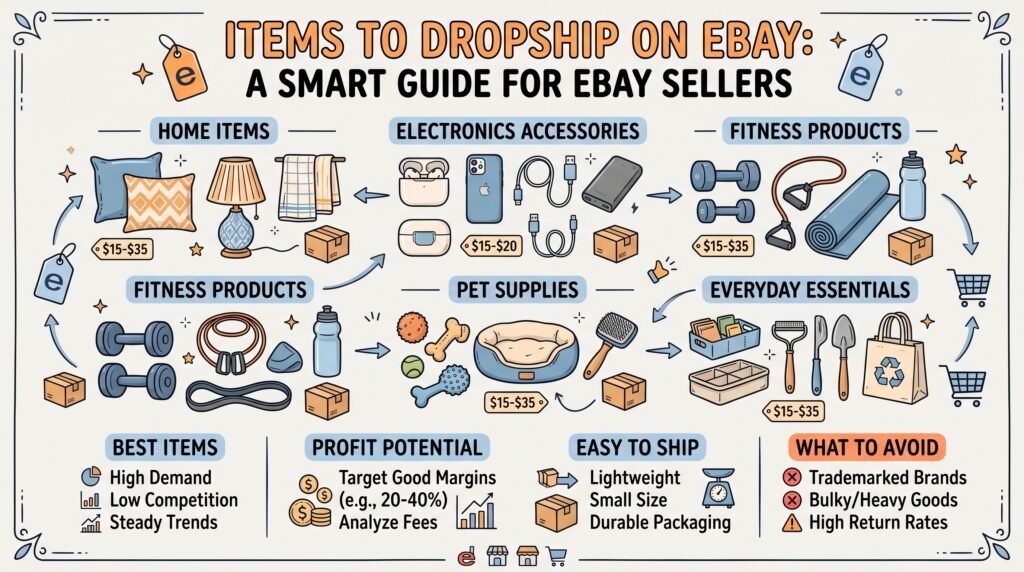
Best Items to Dropship on eBay
There is no single product that guarantees success. The right choice depends on demand, competition, supplier pricing, shipping costs, and your ability to manage the listing.
Still, some categories can be useful starting points for product research.
Home Organization Products
Home organization is a broad category with many practical products. Storage baskets, drawer organizers, cable management accessories, shelf organizers, and small storage solutions can appeal to buyers who want to make better use of their space.
These products are often relatively simple to describe and can be easier to ship than large furniture or fragile household items.
The key is to avoid choosing products solely because they look popular. Check the actual selling price, supplier cost, shipping charges, and competition before listing.
Kitchen Accessories
Small kitchen accessories can also be worth researching. Examples include reusable storage solutions, kitchen organizers, measuring accessories, utensil holders, and non electronic cooking accessories.
Products should have clear descriptions and specifications. Avoid making unsupported claims about health benefits, performance, or safety.
It is also important to check whether a particular product or category has additional marketplace restrictions before listing.
Pet Accessories
Pet owners regularly purchase accessories for dogs, cats, and other household pets. Products such as grooming tools, feeding accessories, travel items, toys, and storage products may provide opportunities for sellers.
Pet accessories can work well when they are lightweight and straightforward to use.
However, sellers should be careful with products that could create safety concerns. Product quality matters because a defective pet product can result in complaints, returns, or potential liability.
Automotive Accessories
Small automotive accessories can attract buyers who want inexpensive solutions for vehicle organization, cleaning, storage, or convenience.
Examples may include organizers, cleaning accessories, storage solutions, and certain non critical interior accessories.
Compatibility is especially important in this category. A listing should clearly state which vehicle models or specifications the product supports. Incorrect compatibility information can quickly lead to returns and negative feedback.
Office and Desk Accessories
Remote work, home offices, students, and small businesses create ongoing demand for desk related products.
Cable organizers, document holders, desk storage products, laptop stands, mouse pads, and similar accessories can be worth researching.
The advantage of this category is that many products are small and relatively easy to ship. Sellers should still compare supplier prices carefully because some office accessories have significant competition.
Fitness Accessories
Small fitness accessories can be another category to research. Examples include resistance bands, workout accessories, storage items, and simple training equipment.
Be careful with products that make medical, therapeutic, or exaggerated performance claims. Product descriptions should accurately reflect what the item does and should not promise results that cannot be supported.
Phone and Electronics Accessories
Electronics accessories have strong consumer demand, but this category requires more care than many beginners expect.
Cases, stands, holders, cable management products, and certain basic accessories may be easier to manage than complex electronic devices.
Compatibility should be clearly explained. Sellers should also verify product quality, certifications where applicable, warranty terms, and supplier reliability before listing.
How to Research the Best Items to Dropship on eBay
Choosing products should be based on evidence rather than guesswork.
Check eBay Search Results
Start by searching eBay for products you are considering. Look at the number of competing listings, price ranges, product conditions, shipping options, and how sellers present their products.
You can also study completed or sold listings where available to understand whether buyers are actually purchasing similar products.
The goal is to find a balance between demand and competition. A product with thousands of identical listings may be difficult for a new seller to compete with.
Calculate the Real Profit Margin
Never calculate profit by simply subtracting supplier cost from your selling price.
Your calculation should consider the product cost, shipping, marketplace fees, payment related costs where applicable, advertising expenses, returns, refunds, and other operating costs.
For example, if a product sells for $40 and your supplier charges $22, that does not mean you automatically make $18. Your actual profit may be considerably lower after all business expenses.
A simple spreadsheet can help you compare products before publishing listings.
Research the Supplier
A supplier can have as much impact on your business as the product itself.
Look for suppliers with reliable inventory, reasonable processing times, accurate product information, consistent product quality, and clear communication.
Ask how they handle returns, damaged products, tracking information, stock changes, and customer orders.
If you are using a wholesale supplier for eBay dropshipping, make sure your relationship and agreement support your right to list and sell the products. eBay specifically distinguishes legitimate wholesale dropshipping from purchasing products from another retailer or marketplace after an eBay sale.
eBay Dropshipping Rules Sellers Should Understand
Product selection is only one part of running an eBay dropshipping business. Sellers are responsible for following eBay’s selling policies and applicable laws.
Wholesale Supplier Relationships Matter
eBay allows dropshipping through wholesale suppliers, but sellers need an appropriate relationship with the supplier before listing products.
Simply finding a product on another retail website and copying it into an eBay listing does not create an approved dropshipping arrangement.
eBay states that buying an item from another retailer or marketplace after it sells on eBay and having that retailer ship directly to the buyer is not allowed.
Shipping Information Must Be Accurate
Your listing should give buyers realistic information about handling and delivery.
If your supplier normally takes several days to process an order, do not promise extremely fast handling simply to make the listing more attractive.
eBay’s terms of sale policy requires sellers to provide clear information about shipping services, costs, handling time, returns, and other important transaction details.
Returns Need to Be Planned
Dropshipping does not remove your responsibility for customer service.
Before listing a product, understand how your supplier handles returns and damaged items. Your eBay return policy should be consistent with your actual ability to handle those situations.
A supplier refusing a return does not automatically remove your responsibilities to the eBay buyer.
Keep Product Information Accurate
Product titles, descriptions, images, specifications, prices, and stock information should accurately represent what the customer will receive.
If your supplier changes a product or runs out of stock, update your listing promptly. Selling products that are no longer available can lead to canceled orders and poor seller performance.
Common Mistakes New eBay Dropshippers Make
Choosing Products Only Because They Are Popular
High demand does not automatically mean high profit. Popular products often attract many sellers, making price competition difficult.
Ignoring Supplier Reliability
A low supplier price is not useful if orders arrive late or products regularly arrive damaged.
Using Retail Websites as Suppliers
This is one of the most important policy issues to understand. eBay does not permit the model where you list a product and then purchase it from another retailer or marketplace after receiving the eBay order.
Making Unrealistic Delivery Promises
If your supplier cannot consistently meet your advertised handling and delivery times, change the listing or find a better supplier.
Forgetting About Returns
Returns are part of selling online. A product that looks profitable before considering returns may become unprofitable after repeated refunds and return shipping costs.
How to Build a Better eBay Dropshipping Strategy
Start with a small selection of products instead of uploading hundreds of listings without research.
Choose products that fit a clear category and study their prices, competition, demand, shipping requirements, and supplier performance.
Once a product begins generating sales, monitor its performance. Watch your profit margin, customer questions, returns, delivery times, and supplier stock levels.
Your listings should also be written for real buyers. Use clear product titles, accurate specifications, useful descriptions, and appropriate images. Avoid stuffing keywords into titles or descriptions simply to gain visibility.
For sellers using third party fulfillment, eBay also expects the seller to remain responsible for the customer experience. Its guidance notes that third party fulfillment arrangements should identify the seller on packing slips and invoices and protect eBay order information from being used for unrelated purposes.
Frequently Asked Questions
What are the best items to dropship on eBay?
The best products are usually those with steady demand, manageable competition, reasonable profit margins, low shipping risk, and reliable wholesale supply. Home organization products, pet accessories, office accessories, kitchen products, and certain automotive or electronics accessories can be worth researching.
Is eBay dropshipping allowed?
Yes. eBay allows dropshipping when orders are fulfilled through a wholesale supplier or another permitted fulfillment arrangement. Sellers remain responsible for delivery and customer satisfaction. Buying products from another retailer or marketplace after an eBay sale and having that retailer ship directly to the customer is not allowed.
Can I dropship from Amazon to eBay?
Using Amazon or another retail marketplace as the source after an eBay customer places an order is not permitted under eBay’s dropshipping policy. The safer approach is to work with a legitimate wholesale supplier under an appropriate agreement before listing products.
How much money do I need to start eBay dropshipping?
There is no single amount that applies to every seller. Your starting budget depends on listing costs, supplier requirements, marketplace fees, advertising, refunds, and working capital. You should have enough funds to handle orders and unexpected customer service costs.
Should beginners sell expensive products?
Beginners may find moderately priced products easier to manage because extremely expensive products can involve greater financial risk, higher customer expectations, and potentially costly returns. Product economics matter more than simply choosing a high selling price.
Final Thoughts
Finding the best items to dropship on eBay is less about discovering one secret product and more about making good decisions consistently. A product with reliable demand, reasonable competition, healthy margins, easy shipping, and dependable wholesale supply gives you a stronger starting point.
Your supplier relationship matters just as much as your product research. Before publishing a listing, confirm that you have the right to sell the product, understand the supplier’s fulfillment process, and can meet the shipping and return terms shown to buyers.
eBay’s policies can change, so sellers should review the current rules before making business decisions. Following the marketplace requirements, keeping listings accurate, and putting customer service first can help create a more sustainable eBay dropshipping operation.