
Anyone researching online selling has probably come across the idea of dropshipping from Walmart to Shopify. It sounds simple on paper. You list a product from Walmart on your Shopify store, a customer buys it, and you order that same item from Walmart to be shipped straight to them. No inventory, no warehouse, no upfront stock purchase. But before jumping into this model, it helps to understand how it actually works, what the risks are, and what Walmart’s own policies say about it, because this method is not as straightforward as many blog posts make it sound.
This article breaks down the real mechanics of sourcing products from Walmart for a Shopify store, the legal and policy issues sellers often overlook, and what alternatives exist for people who want a more stable long term business.
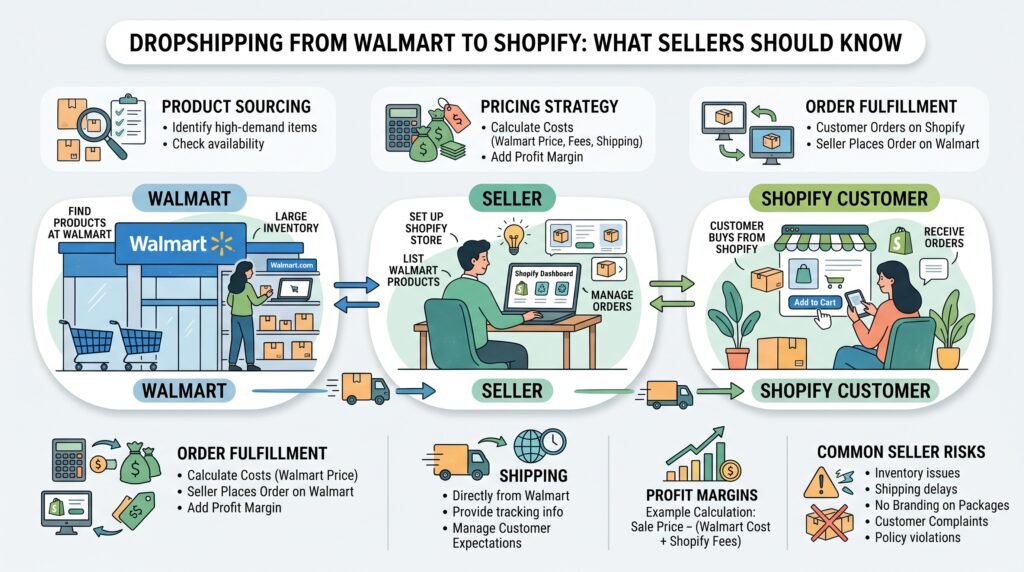
What Dropshipping From Walmart to Shopify Actually Means
At its core, this model works by using Walmart as a supplier without ever holding physical stock. A seller sets up a Shopify store, adds product listings that mirror items sold on Walmart, and prices them higher to cover profit margin. When an order comes in through Shopify, the seller manually or automatically purchases that same product on Walmart.com and has it shipped directly to the customer’s address instead of their own.
This is sometimes called retail arbitrage dropshipping, because the seller is essentially buying at retail price from one platform and reselling at a markup on another. It differs from traditional dropshipping, where a seller works with a wholesale supplier or manufacturer who offers bulk pricing meant for resale.
Why People Are Drawn to This Model
The appeal is easy to understand. Walmart already has a massive product catalog, competitive pricing, and fast shipping in many regions. For someone starting out with little capital, the idea of not having to buy inventory upfront feels low risk. There is no need to rent storage space, manage packaging, or predict demand months in advance.
Shopify, on the other hand, gives sellers full control over branding, store design, and customer experience, which platforms like Walmart Marketplace or Amazon do not always allow to the same extent. Combining the two, at least in theory, lets someone run an independent looking store while relying on Walmart’s supply chain behind the scenes.
The Policy Problem Sellers Often Miss
This is the part that many articles about dropshipping from Walmart to Shopify skip over, and it matters more than most people realize. Walmart’s terms of service are written for individual retail customers, not for resellers. Buying products at retail price with the specific intention of reselling them to someone else, without disclosing that resale relationship, goes against how Walmart’s consumer terms are structured.
In practical terms, this means a few things sellers should be aware of.
Account and Order Restrictions
Walmart uses systems to detect unusual buying patterns, including repeated orders shipped to different addresses that are not the account holder’s own. Accounts flagged for this kind of activity can face order cancellations, payment holds, or account suspension. This is not a rare edge case. It is a documented risk that shows up frequently in seller communities and forums where people share their experiences.
No Bulk Pricing or Reseller Agreement
Unlike a genuine wholesale supplier, Walmart does not offer sellers a formal reseller agreement or bulk discount pricing for this kind of arrangement. Every purchase is made at the same price a regular customer would pay, which puts real pressure on profit margins once Shopify fees, payment processing costs, and shipping variability are factored in.
Inventory and Price Changes Without Warning
Because the seller has no direct relationship with Walmart as a supplier, they have no visibility into stock levels or upcoming price changes. A product listed on a Shopify store might sell out on Walmart’s site within hours, or the price might increase overnight, leaving the seller to either cancel the order, lose money fulfilling it, or scramble to find the item elsewhere.
Is Dropshipping From Walmart to Shopify Illegal
This question comes up often, and the honest answer is that it is not illegal in a criminal sense, but it does go against Walmart’s own terms of service as a retailer. Violating a company’s terms of service is generally treated as a civil and contractual matter rather than a criminal offense. That means a seller is unlikely to face legal prosecution simply for doing this, but they are exposed to very real business risks such as account bans, order cancellations, and payment disputes if Walmart identifies the activity.
Sellers should also think about consumer protection laws in their own country or state. If a customer orders a product through a Shopify store and the packaging, invoice, or return address unexpectedly shows Walmart’s branding, this can create confusion, damage trust, and in some cases lead to complaints or chargebacks. Being transparent with customers about shipping timelines and sourcing, even in general terms, is a good practice regardless of the supplier being used.
What This Means for Store Owners Using Shopify
Shopify itself does not prohibit dropshipping as a business model. Plenty of legitimate Shopify stores work with verified wholesale suppliers, manufacturers, or dropshipping apps that have proper agreements in place. The concern is specifically tied to using Walmart as an unauthorized retail source rather than Shopify’s policies.
Store owners who want to build something sustainable are usually better off treating Walmart sourcing as a short term testing method rather than a long term supply strategy. It can be useful for validating whether a product sells before committing to a more formal supplier relationship, but relying on it permanently tends to create ongoing operational headaches.
Building a More Stable Sourcing Strategy
For sellers who want their Shopify store to grow without constant disruption, a few approaches tend to work better over time.
Working with verified wholesale suppliers through platforms designed for dropshipping gives access to bulk pricing, product catalogs meant for resale, and often faster, more predictable shipping. Many of these suppliers also offer branded packaging or at least neutral packaging, which avoids the confusion that can happen when a customer receives a box with another retailer’s name on it.
Another option is private labeling, where a seller works with a manufacturer to create a product under their own brand name. This takes more upfront effort but builds something that cannot be easily copied or disrupted by a supplier changing prices or running out of stock.
Some sellers also choose a hybrid approach, using Walmart sourcing occasionally for testing new product ideas while maintaining relationships with legitimate suppliers for their core catalog. This keeps the store’s main revenue stream on more solid ground while still allowing some flexibility to experiment.
Practical Steps Before Starting
For anyone still considering dropshipping from Walmart to Shopify despite the risks, a few practical steps can reduce the chances of running into trouble.
Reading Walmart’s current terms of service in full is worth the time, since policies do get updated periodically. Setting realistic expectations around profit margins is also important, since prices on Walmart can shift without notice. Being upfront with customers about shipping times, rather than promising fast delivery that depends entirely on a third party retailer, helps avoid disputes later on. And keeping a close eye on order confirmations and tracking numbers matters, since cancellations on Walmart’s end can leave a Shopify order unfulfilled if not caught quickly.
Final Thoughts
Dropshipping from Walmart to Shopify is a model that attracts a lot of new sellers because it feels accessible and low risk on the surface. In reality, it comes with policy restrictions, unpredictable pricing, and account risks that are easy to underestimate. It can serve as a way to test product ideas quickly, but building a Shopify store meant to last usually requires moving toward proper wholesale relationships or original product sourcing over time.
Anyone building a long term business should weigh the short term convenience of this method against the operational risks it carries, and plan a sourcing strategy that can hold up as the store grows.